Nematodes, or nematodes themselves (Nematoda), are a type of protostomes, protocavities, bilaterally symmetrical molting animals.
Extension. Nematodes are one of the most widespread types of animals that have been able to colonize a variety of habitats, from interstitium (the space between grains of sand) and moss communities to Arctic ice (such asTheristis Melnikovi and cryonema crissum, which is found in the thickness of long-standing ice in the central part of the Arctic Ocean).Parasitic nematodes are of particular interest to researchers, including due to the wide variety of their hosts.
Construction plan. Thin and fusiform body, tapering towards the ends, with a round cross section.The mouth is located at the front end and the dust (anus) at the rear.The outside of the body is covered by a multilayer elastic cuticle, a non-cellular formation secreted by the hypodermis.The hypodermis or epidermis is located below the cuticle.The muscles are represented by a layer of obliquely striated longitudinal muscle fibers.The primary body cavity (schizocele), devoid of its own epithelial lining, is filled with fluid.
Digestive system. The mouth opening at the anterior end of the body is surrounded by protuberances - lips (usually three) and leads to a muscular ectodermal pharynx with a triangular lumen.The pharynx leads to the endodermal midgut from a single layer of columnar epithelial cells.Next comes a short ectodermal hindgut, which opens into the anus.
excretory system. The excretory organs are single-celled glands that replaced the protonephridia.Usually there is a cervical gland at the front of the body, from which a short excretory duct arises.There are also "storage kidneys", phagocytic organs that accumulate insoluble metabolic products that are not eliminated from the body.
Circulatory and respiratory systems. These systems are missing.Respiration occurs through the skin.Anaerobic metabolism (anaerobic breakdown of glycogen into butyric and valeric acids in parasites) is also possible.
Nervous system. The nervous system is of the scalariform type.Represented by a nerve ring and six longitudinal trunks.The two nerve trunks that run along the ventral and dorsal lines are more powerful and are connected by semicircular nerve bridges (commissures).
Sense organs. There are papillae and setae, organs of touch located around the mouth.Some representatives of the sea have primitive eyes - age spots.The chemical sense organs, amphids, are usually pocket-shaped, spiral-shaped, or slit-shaped.They are located on the sides of the head and are especially well developed in males, as they help find females.
Reproduction and development. Nematodes are dioecious animals.The internal genital organs are paired and have a tubular structure.Reproduction is only sexual.Sexual dimorphism is pronounced: females are larger, in males the posterior end of the body is curved.Fertilization is internal and viviparity occurs.In development, nematodes go through four larval stages, separated by molting, which are accompanied by shedding of the cuticle.The third stage in some species (including the famous Caenorhabditis egans) under unfavorable conditions, it passes into the so-called dauer stage, a resting larva.
Parasitism. Currently, of the more than 24,000 species of nematodes described, approximately half are parasitic.They can affect almost all tissues and organs: connective tissue, muscles, blood and lymphatic vessels, gonads, sensory organs, as well as the body cavity, etc.These include ectoparasites and endoparasites of plants, vertebrate and invertebrate animals, including other nematodes, and even protozoa.
The following are descriptions of the most important representatives of nematodes from the point of view of medical parasitology.
human worm(Ascaris lumbricoides)
Appearance.The body, pointed at the ends, is pinkish white.Dimensions: males - 15-25 cm, females - 20-40 cm.The body is covered by a flexible ten-layer cuticle that protects from mechanical stress and the host's digestive enzymes.
Extension. The species is cosmopolitan: it is distributed everywhere, but in different countries the percentage of infected people is different.In Japan, for example, more than 90% of the population is infected with intestinal worms due to the use of human excrement as fertilizer.In areas with hot, dry climates, roundworms are less common.
Life cycle.Development continues without changing owners.Adult worms parasitize the small intestine and cause ascariasis.A person is usually affected by several dozen intestinal worms (the record is 900 pieces).Lifespan in the intestines is about one year.Nematodes are dioecious, like other nematodes.A sexually mature female lays about 200 thousand oval-shaped eggs per day, which are released into the external environment with feces.Roundworms are classified as geohelminths: they require the development of a larval stage in the soil.When exposed to favorable conditions (moist soil at a temperature of about 25 °C and with sufficient access to oxygen), a larva develops in the egg.The development period varies from 16 days to several months and depends on air temperature.These eggs containing a larva can be considered invasive.
Infection occurs when eggs are ingested in food or water;Transmission does not occur directly from person to person.In the intestine, the larvae pass through the intestinal wall, enter the blood vessels and liver, and then migrate through the inferior vena cava to the right atrium and ventricle.From the latter, the larvae pass through the pulmonary circulation to the lungs, where they pass from the blood to the pulmonary vesicles, bronchi, trachea and oral cavity.Secondary infection occurs in the oral cavity: the larvae are swallowed, enter the intestine and reach sexual maturity after three months.The "growth" process in nematodes is associated with molting (usually four of them).
Clinical picture of ascariasis. In the migratory stage of ascariasis, coughing (helps the larvae reach the throat), chest pain, allergic reactions and fever are observed.
At the intestinal stage, damage to the intestinal mucosa and poisoning of the body with toxic metabolic products occurs.Symptoms: nausea, vomiting, stool disorders, loss of appetite.
Long-term effects of infection: general decrease in performance, sleep disturbances.When the worms enter the bile ducts and respiratory tract, the result is fatal.In addition, roundworm larvae can enter the brain (for example, from the inferior vena cava to the superior vena cava, then along the brachiocephalic vein), causing meningoencephalitis, accompanied by migraines.
Prevention. Wash your hands before eating and preparing food.Washing vegetables and fruits.Eggs are also carried by flies, so fighting these diptera using, for example, Velcro also helps prevent ascariasis.
Interesting fact. There are studies showing the positive effects of roundworm infection in relieving symptoms of autoimmune diseases and increasing fertility in women.Scientists attribute this to the parasites' effect on the immune system by influencing the level of T cells in the body, but at the moment the mechanism is not too well understood to draw reliable conclusions.
pinworms(Enterobium vermicularis)
Appearance. Grayish white nematode, males 2 to 5 mm long, females 8 to 14 mm long.The end of the tail is pointed (hence the name).At the anterior end of the body, a characteristic swelling of the esophagus is noted.
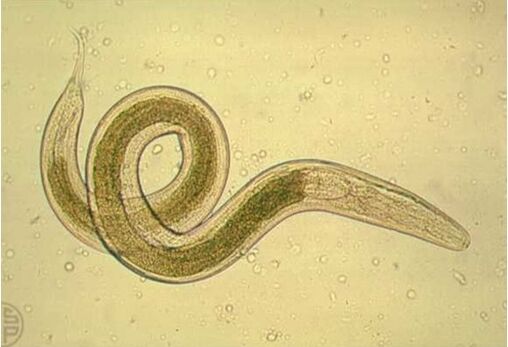
Life cycle.Pinworms parasitize the lower part of the small intestine and large intestine, causing enterobiasis.Shelf life is 1 to 2 months.The anterior end of the pinworm attaches to the intestinal wall.A sexually mature female leaves the large intestine through the anus and lays from 5 to 15 thousand eggs on the skin near the anus, after which she dies.
Crawling in females is accompanied by itching.By scratching the skin, the eggs are transferred to the hands and more.Flies are also involved in egg transfer.Infection occurs through ingestion.The larvae hatch from eggs that enter the intestines.
Epidemiology and clinical picture of enterobiasis. Enterobiasis is widespread, especially in children due to non-compliance with personal hygiene rules and "overcrowding" in kindergartens and schools.Transmitted from person to person without an intermediary host.Reduces the effect of vaccines.
Symptoms: abdominal pain, loss of appetite, headaches, allergic manifestations, perianal itching (produces sleep disturbances, increases irritability).
Trichinella(Trichinella spiralis)
Description.Small nematode 2-4 mm long.Parasitizes the mucosa of the small intestine.Distributed in Eurasia and North America.
Life cycle. A change of host is necessary for the development of Trichinella.These are usually wild animals (foxes, wolves, bears, wild boars), as well as people and livestock.Females are anchored by the anterior end of the body to the intestinal epithelium and give birth to between 1,000 and 2,000 larvae.Ovoviviparity is typical: hatching of larvae from eggs occurs in the female genital tract.The larvae are transported throughout the body through blood and lymphatic vessels and settle in the striated muscles.At this stage they have a stylet, which they use to destroy muscle tissue, causing the host to form a capsule in which, curled up, they reside in the future.After a few months, the capsule is soaked in lime.This muscular trichina can exist for several years and survive even after the death of the owner and the decomposition of his corpse.
Once in the stomach of the new host (after eating the corpse of the previous one), the larvae are released from the capsule, penetrate the mucous membrane and in a couple of days, having gone through four molts, turn into adult worms.
Clinical picture of trichinosis. Increased temperature, swelling of the face, muscle pain, allergic reactions.
Prevention. Trichinosis is transmitted through food through contaminated meat.Therefore, to prevent the disease, the meat must undergo a veterinary examination and properly prepare: boil for 2 to 3 hours.Cooking methods such as smoking and salting do not destroy Trichinella.
whipworm(Trichocephalus trichurus)
Appearance.The worm is whitish in color and measures about 4 cm long.The front part is thin, reminiscent of hair (hence the name).
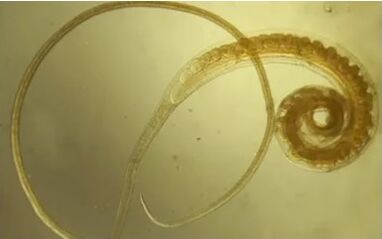
spreading.They prefer countries with a humid and warm climate.
Life cycle.The worm parasitizes in the initial part of the large intestine, only in humans.Causes trichuriasis.The life expectancy of a person is several years.The thin end penetrates the thickness of the mucous membrane of the intestinal wall.It feeds on tissue fluid and blood.
The female lays between 1 and 3 thousand eggs, which are released into the external environment with feces.Like the roundworm, the whipworm is related to soil-transmitted helminths: for the eggs to become invasive, they need to remain in the soil at a certain humidity and temperature (25-30°C) for a month.After this, infection occurs when the eggs are swallowed;The larvae emerge from them in the intestines of the host, penetrate the intestinal villi and grow in them for about a week.Then, after destroying the villi, they go out into the intestinal lumen, reach the large intestine, settle there and reach maturity within a month.
Clinical picture of trichocephalosis. The worm damages the mucous membrane of the colon and causes poisoning of the host with waste products.Whipworm is a hematophagous, so it can cause anemia.Trichocephalosis is accompanied by abdominal pain, headaches and dizziness.Because whipworm attaches to the intestinal wall, it is more difficult to remove from the host than other parasites.
ristha(Dracunculus medinensis)
Appearance.A slender, whitish nematode, females are between 30 and 120 cm long and males are no longer than 4 cm.There is a small thorn on the tail.
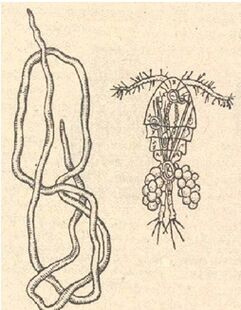
Distribution: Tropical countries of Asia and Africa.
Life cycle.Infection occurs by drinking unboiled water containing copepods.The crustaceans in the stomach die under the influence of hydrochloric acid, but the larvae of the Guinea worm survive and spread throughout the body through the lymphatic system.They then penetrate the body cavity, molt there and reach sexual maturity.After mating, the male dies, and the female passes into the subcutaneous tissue, where a purulent abscess is formed, accompanied by burning and pain.Cold water is best for pain relief.
The development of the eggs forces the female to begin moving her “head” towards the surface of the skin, leaving in its wake an inflammatory process that turns into a purulent abscess, which then bursts.When the female's uterus enters the water, it ruptures and the larvae hatch from the eggs.In order for development not to be interrupted, the larvae must infect the cyclops crustacean, which is an intermediate host.Those larvae that remain in the water die.After the crustaceans are swallowed by the definitive host, under the influence of stomach acid, the crustaceans dissolve and the larvae easily enter the intestine, break through its walls and end up in the lymph nodes, where the development cycle continues.The disease caused by Guinea worm is called dracunculiasis.
dracunculiasis.The incubation period lasts up to nine months and ends when the female reaches sexual maturity.And in a person who has already fallen ill with dracunculiasis, at this time purulent abscesses begin to form.The only salvation from pain is a pond.The relief is immediate, but upon contact with water the bubbles burst and the guinea worm throws the larvae into the water.The crustaceans consume them and the life cycle begins again.
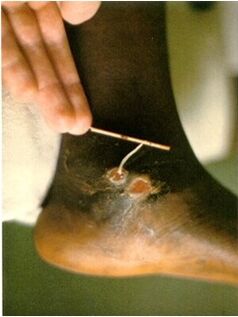
When treating dracunculiasis, an incision is often made at the site of the blister and the worm is gradually removed by wrapping it around a stick.This takes days, sometimes weeks (you have to remove the worm slowly and carefully so it doesn't break).It has been suggested that the appearance of a guinea worm coiled around a stick became a kind of prototype for the symbol of medicine - the staff of Asclepius entwined with a snake.
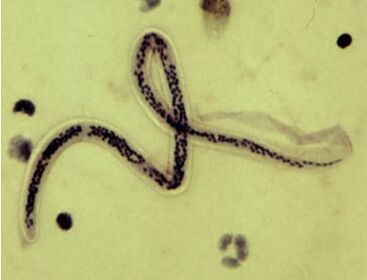
Bancroft's filament (filaria) or Bancroft's thread(Wuchereria bancrofti)
Appearance.White thread nematode, females 10 cm long, males 4 cm long.
Distribution. Tropics, subtropics of Asia, Africa, Central and South America.
Life cycle. In adults it usually appears in the lymph nodes and vessels, obstructing lymph drainage and causing persistent swelling.Females produce larvae - nocturnal microfilariae, which appear in the peripheral blood at night and during the day penetrate deep into the body (into the pulmonary vessels and kidneys).This is because the intermediate host is mosquitoes, which usually suck blood in the afternoon and at night.The larvae enter the mosquito's stomach, then into the body cavity, where they grow, after which they accumulate near the proboscis, from where they are transmitted to humans by sucking blood.Bancroft's filaments cause elephantiasis, or elephantiasis, or elephantiasis.It is worth noting that this disease can also be caused by other nematodes.
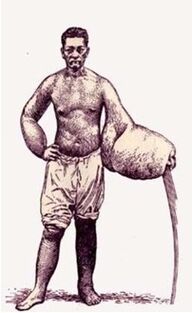
Clinical picture and treatment of elephantiasis. Enlargement of any part of the body occurs due to hyperplasia (painful growth) of the skin and subcutaneous tissue, which is caused by inflammatory thickening of the walls of lymphatic vessels and stagnation of lymph, which occurs due to obstruction of lymphatic vessels by adult Bancroft filamentous individuals.The skin of the diseased part of the body becomes covered with ulcers.
The treatment of elephantiasis aims to improve fluid outflow.The use of anthelmintic drugs is effective.In later stages, surgery may be required.